Casinos
 Betting
 Games
Games 
 Payments
  Casino Bonus

Why US Dollars Dominate Online Casino Payments (Even for Canadian Players)

- Why US Dollars Dominate Online Casino Payments (Even for Canadian Players)
 Author: Lukas Mollberg
 Updated: 20 May, 2026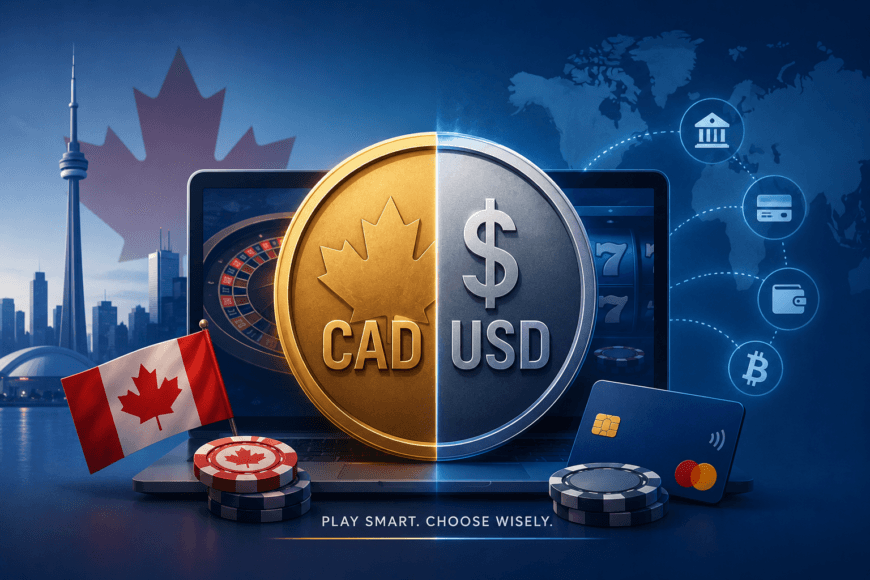
If you have ever signed up at an online casino and found your account defaulting to US dollars, you are not alone. This is one of the most common frustrations among Canadian gamblers online. It has less to do with oversight than with how the global iGaming industry was built. The dominance of USD in online casino payments is structural. It reflects decisions made at the software, licensing, and payment infrastructure levels — well before any individual Canadian player creates an account.
The gap between the Canadian dollar and the US dollar matters more in online gambling than in most other digital transactions. The CAD typically trades at a discount to the USD, hovering around 0.72 to 0.75 USD per CAD in recent years. Playing in USD on a CAD budget means you start every session with reduced purchasing power. A $100 CAD deposit might only register as $74 USD in your account. That difference affects your bet sizing, your bonus value, and ultimately your withdrawals. We at Casinoble have seen this confusion play out repeatedly among Canadian players comparing platforms, and the root causes are worth understanding clearly.
Understanding why this happens means looking at the iGaming ecosystem as a whole. That includes the software providers, the payment processors, the licensing jurisdictions, and the behavioral tendencies of players navigating platforms not always designed with Canadian users in mind.
How the iGaming Industry Was Built Around the US Dollar
The online casino industry did not emerge from any single country. It grew out of software development hubs in Malta, Latvia, Gibraltar, and the Isle of Man, serving a global audience under permissive licensing jurisdictions like Curaçao and the MGA. The US dollar became the natural anchor currency for this infrastructure. That was not because the industry deliberately excluded other markets. It happened because USD dominates international trade and digital commerce broadly. For a broader look at how USD functions across the global casino landscape, the top USD online casinos resource at OnlineCasinoRank offers useful comparative context.
Game studios like Pragmatic Play, Evolution Gaming, and Microgaming calibrate return-to-player rates, bet ranges, and prize structures in USD. The betting parameters displayed in-game, the jackpot counters ticking upward, the bonus thresholds — studios denominate almost all of these in USD or EUR first. Other currency displays sit as a conversion layer on top. When a Canadian player sees a $1,000 welcome bonus in CAD, that figure may have started as a USD amount. The platform converts it at a fixed internal rate, which does not always match the real-time market rate. Players browsing online casino options in Canada often encounter this without realizing it.
The Role of Payment Processors and Licensing
Payment processors form the second layer of the problem. Most international payment gateways route transactions through USD as a settlement currency. This means that even when a platform technically accepts CAD, the underlying transaction may still pass through a USD conversion somewhere in the chain. When a Canadian player deposits funds, the casino's payment processor converts CAD into the operating currency — usually USD or EUR — at the current exchange rate, plus any margin the processor or casino adds. The casino then credits the player's account in that converted amount. On withdrawal, the process reverses, and the exchange rate applies again at whatever value it holds at that moment.
Licensing jurisdiction also plays a role. Casinos operating under a Curaçao license — among the most common for platforms accepting Canadian players — face no requirement to offer CAD-native account management. Their compliance frameworks run on USD or EUR as base currencies. Platforms under MGA licensing or regulated by iGaming Ontario tend to integrate CAD more thoroughly. But even there, the backend software powering the platform may still run natively in USD.
The Real Cost of Playing in USD as a Canadian
The practical impact of USD-denominated accounts is not abstract. USD deposits require currency exchange at prevailing rates, typically adding 1 to 3 percent in processing fees. That fee can appear at both the deposit and withdrawal stages. Those conversion margins add up over many sessions. A player depositing $200 CAD weekly at a 2.5% conversion fee loses roughly $260 CAD annually to currency friction alone — before a single bad beat or house edge calculation enters the picture.
There is also a psychological dimension that is easy to underestimate. During fast-paced games, switching between CAD and USD in your head can cause you to bet more than planned. When you think in Canadian dollars but your balance reads in USD, the mental conversion adds friction to every decision. A $50 USD bet feels different to a Canadian player than the $68 CAD equivalent. This distortion is subtle, but it consistently disadvantages the player's bankroll management.
The issue extends to bonuses as well. When a casino advertises a bonus in USD and you deposit in CAD, the bonus value you receive may fall short of what was advertised once conversion applies. Players seeking Canadian dollar casino options to avoid this kind of mismatch are making a financially rational decision, not just a preference-based one.
Why Many Platforms Still Default to USD
Despite the availability of CAD-compatible platforms, a significant share of online casinos still default to USD for Canadian players. The reasons are partly technical and partly commercial. On the technical side, many white-label casino platforms let operators launch branded casinos quickly without building proprietary software. These platforms ship with USD as the default currency because it simplifies setup. Localizing for CAD means extra integration work — CAD-compatible payment methods, currency display settings, and adjusted promotional material.
On the commercial side, some operators prefer USD accounts because they simplify reporting and cut foreign exchange management complexity. A $500 welcome bonus means the same thing to a player in New Zealand, Canada, or Brazil when the account runs in USD. Operators with leaner setups find this standardization easier than maintaining localized currency accounts for each target market.
Canadian players also contribute to this dynamic through their own behavior. Many accept the USD default without questioning it, especially when a credit card or e-wallet handles the conversion invisibly. Players using Interac for online casino deposits notice the conversion more directly. Interac is a CAD-native system, so the discrepancy between the amount sent and the amount credited becomes immediately visible.
Comparing USD vs CAD Casino Account Options
The table below outlines the key differences between a USD-denominated account and a CAD-denominated account for a Canadian player, to help decide which to seek out.
| Factor | USD Account | CAD Account |
|---|---|---|
| Currency conversion on deposit | Yes, typically 1–3% fee | No |
| Currency conversion on withdrawal | Yes, applies again at cashout | No |
| Bonus value accuracy | May differ from advertised CAD equivalent | Matches advertised amount |
| Bankroll tracking clarity | Requires mental conversion | Direct, no conversion needed |
| Payment method compatibility | Broad (cards, e-wallets) | Best with Interac, CAD e-wallets |
| Exchange rate risk | Exposed to CAD/USD fluctuations | None |
| Platform availability | Very high (most casinos offer USD) | High and growing (most reputable casinos) |
A CAD account suits a Canadian player's needs better in almost every dimension. The only area where USD accounts hold an advantage is raw availability — more platforms default to USD than to CAD. That said, the number of quality platforms supporting CAD has grown considerably, and the practical reasons to accept a USD-default account have weakened accordingly.
Alternatives That Bypass the Currency Problem Entirely
Crypto Payments and the USD-CAD Question
A growing category of payment approaches sidesteps the USD-CAD conversion question altogether. Cryptocurrency transactions carry no fiat currency denomination at the point of transfer. A Bitcoin or Ethereum deposit goes into a casino wallet in its native form. The platform only converts it to a display currency at the account level. For players comfortable with crypto, this cuts the bank or payment processor's conversion margin out of the equation entirely. Players exploring Bitcoin casino platforms for this reason respond rationally to a genuine financial inefficiency in the traditional payment system.
Stablecoins like USDT offer a partial solution. They eliminate volatility, but they remain pegged to the USD. A Canadian player using USDT still operates in USD terms at the value level. Players comparing Tether casino payment options will find that USDT's main draw is speed and low transaction cost, not currency alignment. The absence of a banking intermediary and near-instant settlement make stablecoins attractive for players who prioritize speed and low fees over currency matching. Industry analysts note that 38% of online casinos now accept USDT as a regular payment method. A SoftSwiss survey found that 67% of players want to receive winnings in stablecoins for the speed and convenience.
Choosing the Right Fiat Path
For players who prefer fiat, the most practical route is choosing platforms that explicitly support CAD accounts with native CAD-compatible payment methods. This ensures that neither the deposit nor the withdrawal triggers a conversion, and that bonus terms and promotional figures reflect actual CAD values.
- Look for casinos that list CAD explicitly under supported currencies, not just as a conversion option.
- Confirm that your preferred payment method settles in CAD at the processor level, not just at the display level.
- Review the withdrawal terms for any mention of conversion fees, especially if the platform's backend operates in USD.
- For players interested in fast payouts, platforms offering under one-hour withdrawal processing are more likely to have streamlined payment infrastructure that handles CAD cleanly.
What Canadian Players Should Look for Before Depositing
The single most important step a Canadian player can take is to confirm the account currency at registration, not afterward. Choosing CAD during account creation aligns transactions directly with Canadian banking sources and cuts out the initial conversion steps. Changing the currency afterward often means contacting support, and some platforms refuse the change entirely. Once an account is set to USD, that conversion machinery runs on every subsequent transaction.
Beyond the currency setting itself, Canadian players should evaluate:
- Whether the platform holds a license from a credible authority such as the MGA, Kahnawake Gaming Commission, or iGaming Ontario.
- Whether the available payment methods include at least one that processes in CAD natively, without routing through an international USD gateway.
- Whether bonus terms specify amounts in CAD, or whether they use USD figures with a conversion note buried in the fine print — a common issue with casino welcome bonus offers that reference USD values by default.
- Whether the platform's customer support team can confirm, in plain language, the exact currency path a deposit follows from initiation to account credit.
Players who spend time on these questions before committing to a platform avoid the most common sources of currency-related frustration. The effort takes a few minutes and can prevent weeks of confusion about why withdrawals come back lower than expected.
Conclusion
The dominance of USD in online casino payments is not accidental. The iGaming industry built its infrastructure around global reach, USD-native software, and licensing frameworks that prioritized scale over local currency precision. For Canadian players, this creates persistent friction — conversion fees, bonus value discrepancies, and the challenge of managing a bankroll in a foreign currency. The good news is that the market has matured. Genuine CAD-native options exist and are not hard to find with the right approach. At Casinoble, our goal is to make those options easier to identify and compare, so Canadian players can make decisions based on the actual terms of play rather than discovering the fine print after the fact.

Lukas Mollberg
Casino Expert | Head of Content at CasinobleLukas Mollberg is an experienced iGaming analyst and editorial lead with more than twenty years in gaming and digital media, including over eight years focused on online casinos. As Head of Content at Casinoble, he guides the editorial team, shapes review methodology, and ensures that research and analysis are grounded in verified data and clear evaluation standards.
Most Recent News
Get the latest information